Wildlife and folklore of the humble hedge

Wildlife and folklore of the humble hedge

Alan Price

Did you know there are 10,377km of hedgerow across Warwickshire? Find out more about how how hedgerows provide for wildlife.

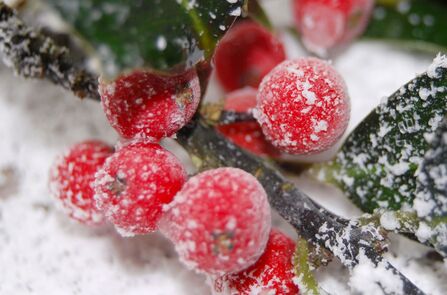
During the chill winter days, our white and frosty landscapes are complemented with the pop of red holly berries. Did you know our ancestors believed holly could repel evil spirits?1 In hedgerows, a single holly tree was often planted to stop witches from running along the top!2 Holly is also one of many hedgerow plants providing birds with berries throughout the winter.1 

Despite their humble appearance, the 10,377km hedgerow across Warwickshire can provide amazing habitat for wildlife when managed well. 1,800 invertebrate species were found in a single hedgerow in a 2015 study!3

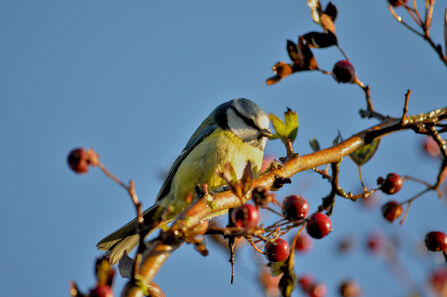
A rich, green and bushy hedgerow

Emma Robertshaw

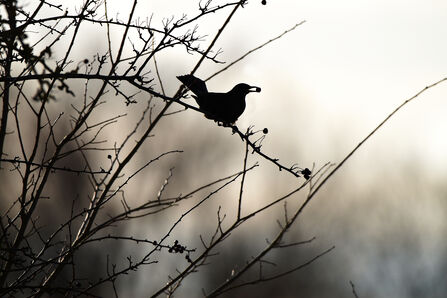
A good hedgerow network for wildlife includes different ‘layers’ – a shrub/scrub layer, hedge trees, a grassy margin and sometimes a ditch or bank.4 Different species use different parts of the hedgerow. Birds will use hedgerow trees as song posts,5 while some bats roost in hedgerow trees – pipistrelles and Bechstein’s bat for example.6 Grass snakes will hibernate at the base of a hedge,7 while blackcaps will nest in scrubby outgrowths of rose or bramble.8 Hedgerows also provide connectivity corridors for wildlife to move across the landscape. 

Hedgerows provide many benefits for people as well. They store carbon, so can be valuable in the fight against climate change.9 There is also good evidence to show that hedgerows can reduce soil erosion, both by reducing the rate of water flow across fields and by blocking soil particles suspended in water.10 This means that they help to prevent soil and any associated pollutants entering rivers and water courses, helping to keep them clean for wildlife to thrive.10 Find out more here about our Wild for Water campaign running currently and which focuses on water quality. 

To provide the most value to wildlife, hedgerow management should aim for a good diversity of native plant species like blackthorn, hazel, holly, hawthorn, spindle, dogwood and wayfaring tree that provide flower and fruit resources at different times of year. It’s particularly important to avoid any invasive plant species that can cause a lot of damage to the environment. 

It’s also great to cut hedges on rotation every three years rather than every year – this can lead to a greater flower and berry abundance for wildlife.11,12 These principles can benefit wildlife whether you manage a rural hedge or a small garden hedge. Find out more about hedgerows and other habitats across Warwickshire through the State of Habitats report, produced this year by the Natural Capital Assessment Partnership

References

  1. Woodland Trust. Holly. 2025. URL: https://www.woodlandtrust.org.uk/trees-woods-and-wildlife/british-trees/a-z-of-british-trees/holly/
  2. RHS. Trees: myths and folklore. 2025. URL: https://www.rhs.org.uk/education-learning/school-gardening/resources/curriculum-linked/trees-myths-and-folklore
  3. Wolton, R. British Wildlife, 2015, pp. 306-316.
  4. Hedgelink. The Complete Hedge Good Management Guide. 2013. URL: www.hedgelink.org.uk/cms/cms_content/files/30_complete_good_hedge_management_guide_leaflet.pdf
  5. Natural England. Hedgerow trees: answers to 18 common questions. Natural England, 2008. URL: https://www.cfeonline.org.uk/archive?treeid=41258
  6. Hedgelink. How to Manage your Hedge for Bats. 2013. URL: www.hedgelink.org.uk/cms/cms_content/files/17_bats_%26_hedges_leaflet.pdf   
  7. Hedgelink. How to Manage your Hedges for Grass Snakes. 2013. URL: hedgelink.org.uk/cms/cms_content/files/36_grass_snakes_%26_hedges_leaflet.pdf
  8. Hedgelink. The Complete Hedge Management Guide for Farmland Birds. Hedgelink, 2013. URL:  hedgelink.org.uk/cms/cms_content/files/31_complete_hedge_management_guide_for_farmland_birds_leaflet.pdf
  9. Biffi et al. Journal of Environmental Management, 2022, 307, pp. 363-370 (114484). DOI: 10.1016/j.jenvman.2022.114484.
  10. Wolton et al. Regulatory services delivered by hedges: the evidence base, 2014. Report of Defra project LM0106.
  11. Staley et al. Biological Conservation, 2012, 145(1), pp. 24-29. DOI: 10.1016/j.biocon.2011.09.006.
  12. Staley, et al. Effects of hedgerow management and restoration on biodiversity, 2018. Defra research project BD2114.