

Working with farmers and landowners
Agricultural land covers 63% of Warwickshire and if we are to realise our vision of landscape recovery, we must work collaboratively with farmers to support nature and wildlife
Warwickshire Wildlife Trust has been working with farmers for decades, supporting them to farm with nature in mind. Our approach is based upon the idea that food production and nature are interconnected. We aim to support farmers in sustainable and nature friendly principles while understanding that a farm needs to produce food to maintain profitability and be resilient to external pressures.
At Groundswell 2025, The Wildlife Trusts launched ‘Food & Farming in a Nature & Climate Crisis’; a vision to maintain the momentum for a transition to more sustainable farming practices in the UK. Considering a turbulent year for farming policy, the vision outlines a continued focus on The Wildlife Trusts working closely with farmers by providing independent advice and campaigning for more public and private funding, especially for investment in more nature-based solutions.

Farm & Wildlife Advice Service
Our team of agricultural advisers help you to access government funding (ELMs including SFI), integrate regenerative principles into your farm system, and provide advice and support on habitat creation.

Warwickshire Sustainable Farming Groups
The county’s leading Farm Cluster Groups, covering Warwickshire, Coventry and Solihull. The three groups offer free monthly events, helping farmers share sustainable farming and wildlife management techniques.

Warwickshire Meadows Hub
Warwickshire Meadows Hub is a partnership created to bring together everyone who’s interested in species-rich meadows, supporting the high-quality restoration, management, and long-term resilience of species-rich grasslands.
Other Support
Tame Valley Wetlands Landscape Partnership
The Tame Valley Wetlands team work with farmers and landowners throughout the River Tame catchment. The team support farmers and landowners with restoring natural features to their land to benefit nature, improve water quality and help reduce flooding risk. Tame Valley Wetlands’ work is enabled by grant-funded projects, meaning a wide variety of work is supported through the team, from river restoration to woodland management.
Dunsmore Living Landscape
The Dunsmore Living Landscape (DLL) team works with farmers and landowners within the scheme area to restore hedgerows, woodlands, ponds and meadows. This includes practical on-the-ground support with the Dunsmore Volunteer team. More details about the Partnership can be found at www.exploredunsmore.org
To get in touch with the Dunsmore Living Landscape team, please email Lucy, DLL Scheme Manager: Lucy.Hawker@wkwt.org.uk.
Sherbourne Valley Project
Led by the Warwickshire Wildlife Trust, the project is working with partner organisations and local communities to re-write the future of Coventry’s River Sherbourne by establishing an urban living landscape in which people, nature and culture can thrive.
Find out more on the Sherbourne Valley Project website.

Sherbourne Valley Project
River & Catchment Restoration Team
The River and Catchment Restoration team work with farmers and landowners across the county, with the location of our delivery being guided by the funding available. We work with farmers to implement natural flood management techniques on their water courses and improve the water holding capacity of the farms. This also improves habitats and increases biodiversity across the farm.
To express interest in support from the River & Catchment Restoration team, please email Liz, River Restoration Officer: Elisabeth.Larner@wkwt.org.uk

Sarah Barnsley
The Natural Capital Assessment Partnership (NCAP)
NCAP, funded by Warwickshire Wildlife Trust and eight local authorities, surveys and records Local Wildlife Sites (LWS); the most important areas for nature at a local level, many are on farms. The team works with landowners to access sites and offer management advice to protect or improve the habitats and species found. Find out more about the NCAP team’s work here.
Why should the Wildlife Trust work with farmers and landowners?
Nearly 70% of England’s land is farmed, so food production has a major impact on the natural environment. Since World War Two intensive agriculture driven by a system focused on maximising yields to feed a growing population through monocultures, uniform livestock breeds, and heavy reliance on pesticides and synthetic fertilisers. However, this has put our environment under strain: pollinators and natural habitats are in decline; carbon is escaping from our exhausted soils and rather than holding water, our soils are washing into our rivers, lacking the resilience to cope under heavy rainfall or drought events. This isn’t the fault of farmers but the result of a system that fails to recognise the true value of nature.
A different path is possible. Many farmers are already proving that working with nature can boost biodiversity and make farms more resilient. Scaling up nature-friendly farming could help tackle the climate and nature crises while supporting rural economies, but it requires shifting away from industrial models toward farming that links food production with environmental health.
We should invest in restoring land and wildlife so they can continue providing what we rely on: sustainable and nutritious food, thriving habitats, flood and drought protection, clean water and air, carbon storage, and spaces for people to enjoy.
To find out more about the Wildlife Trusts vision for food and farming follow this link.
What is nature friendly farming
Nature-friendly farming is an approach to food production that works with natural processes rather than against them. It focuses on healthy soils, diverse habitats, and low-impact practices such as reducing chemical use, protecting waterways, restoring hedgerows, and supporting wildlife on farmland. By valuing biodiversity and resilience, nature-friendly farming aims to produce food sustainably while strengthening the long-term health of the land and the communities that depend on it.
Examples of nature friendly farming include regenerative farming, agroecological farming, and organic farming.
What can you do to support nature friendly farming?
The public can support nature-friendly farming by choosing food that rewards sustainable practices: buying directly from farmers, using local markets, and, for those who can afford it during the cost-of-living crisis, opting for organic or regenerative products from supermarkets. Even small choices help strengthen demand for farming that protects wildlife and soil health. An example of this is the Jordans Farm Partnership between Jordans, the Wildlife Trust, Linking Environment and Farming (LEAF) and UK oat farms. This long-standing collaboration offers an accessible way to support farming that works with nature.
Contact Us
If you are a farmer, grower or landowner looking for advice or support, get in contact directly with one of our teams, or contact us through our Land Advice email: Land.Advice@wkwt.org.uk
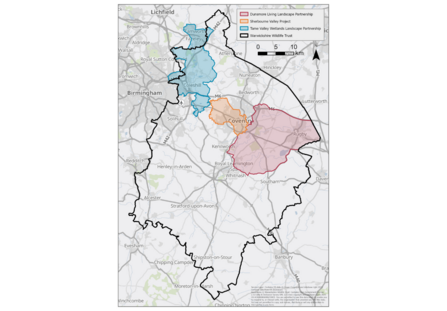
Areas covered by our projects
Take a look at our map showing the areas in Warwickshire in which our projects operate, including the Sherbourne Valley Project, Dunsmore Living Landscape and Tame Valley Wetlands.

A map showing the areas in Warwickshire in which our projects operate, including the Sherbourne Valley Project, Dunsmore Living Landscape and Tame Valley Wetlands