

Oakley Wood tree planting
How we look after the next generation of trees
Warwickshire Wildlife Trust plant and manage trees on many of our 60+ nature reserves across Warwickshire, Coventry, and Solihull. As trees grow slowly, the work we do today will benefit future generations the most. Because we have been continuously managing trees on our sites for over 50 years, we can now see the benefits of previous management in the abundance of wildlife on our nature reserves.
Here are some examples of tree projects taking place on our nature reserves:
Bubbenhall Meadow
Sitting beside the ancient Bubbenhall Wood, Bubbenhall Meadow is former agricultural land, quarried for sand and gravel. It was later restored to a mix of ponds and grassland, with a woodland the size of around 14 football pitches planted in 2010. This woodland is important in providing a connection in the landscape between three large ancient woodlands; Ryton Wood, Wappenbury Wood, and Bubbenhall Wood.
Since the trees were planted, we have been maintaining the woodland through removing tree guards and planting trees to replace any that have died. Previous tree dedications have helped plant a more diverse range of tree species and have replaced many ash tree saplings lost to the disease ash dieback.
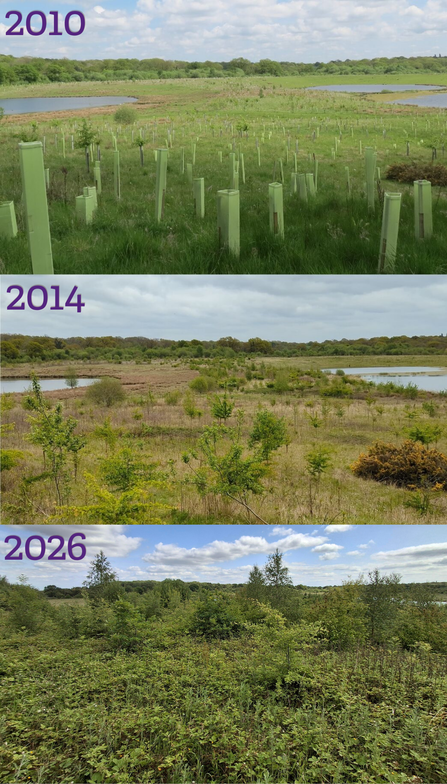
Time lapse of Bubbenhall meadow over 16 years - WKWT
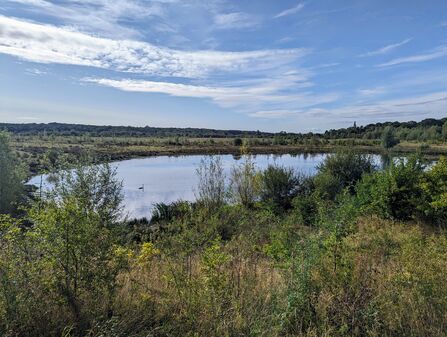
Bubbenhall Wood and Meadow
Brandon Marsh
Just outside of Coventry, our flagship nature reserve, Brandon Marsh is a regionally important wetland site and home to an abundance of wildlife such as wading birds, otters and many species of dragonfly.
The reserve also has pockets of woodland which contain their own important wildlife. Areas of small trees and scrub link up these woodlands so wildlife can move around, but elsewhere, we have created corridors of habitat with hedgerows.
Trees are planted in rows and left to grow bushy and tall to provide cover and nesting for animals. Left too long and they start to become gappy, leggy and less useful as a refuge. Through the traditional management of hedge laying, we partially sever the trees and lay them down to encourage new and lower growth and to return a dense and bushy structure. This improves the hedge for wildlife and prolongs the life of the trees. If trees in the hedge die, we can replace them by planting new ones. This process is called “gapping-up”.
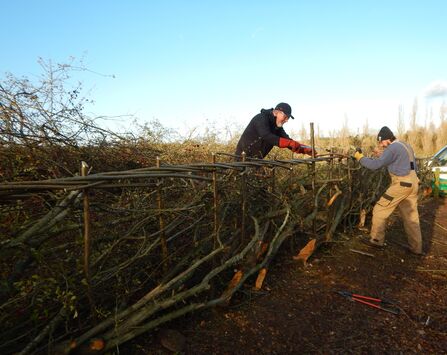
traditional hedge laying techniques at Brandon Marsh
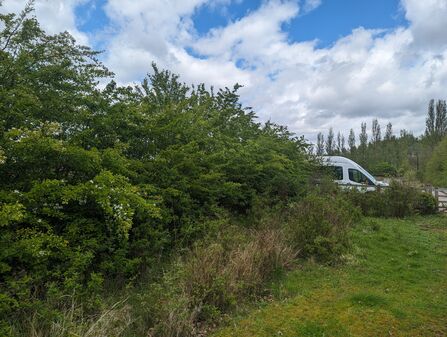
Traditional hedge 6 years after hedge-laying at Brandon Marsh
Oakley Wood
Oakley Wood, just south of Warwick, is what is known as a ‘Plantation on Ancient Woodland Site’. It has been wooded since at least 1600, but after the Second World War the woodland was cleared and replanted with non-native conifers to help provide more timber. As a result, the woodland lacked native trees and was not ideal for wildlife, which would benefit from a more diverse range of trees.
To help more native species grow, Warwickshire Wildlife Trust and Warwick District Council, who own the woodland, are carrying out management over the next 25 years to help restore the site. Conifers are slowly being removed and areas of native trees are being planted in their place. As there are relatively few native trees in the woodland, we plant trees that can grow on to become future seed sources for the woodland. The work is being done gradually as the conifer woodland does still provide habitat for some wildlife.
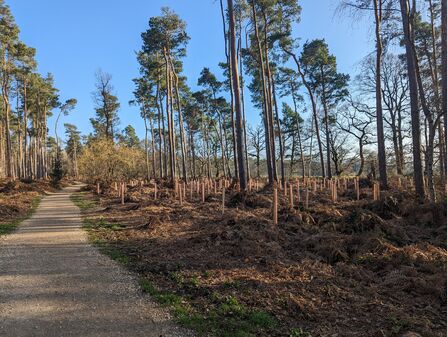
Oakley wood tree planting 2026
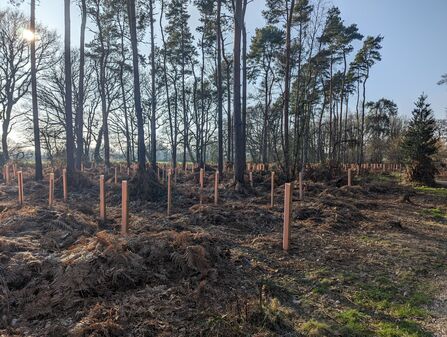
Oakley Wood tree planting
Snitterfield Bushes
Near Stratford-upon-Avon, Snitterfield Bushes is part of what used to be an old wartime airfield. The site is dominated by ash trees and is known for its impressive range of spring flowers.
Unfortunately, the woodland has become infected with the disease ash dieback, threatening to kill most of the ash trees, which is a huge threat to the woodland. We are proactive in our approach to beginning the woodland’s recovery. We have thinned the whole woodland, focussing on removing the weakest ash trees, to allow more light to the woodland floor.
Since then we have begun planting alternative tree species in these tree canopy gaps to provide replacement trees for the ash, and give them a head start before the remaining ash trees decline further.
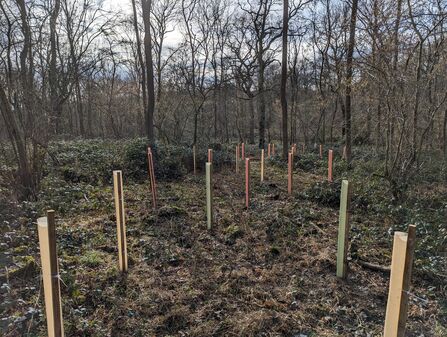
Tree planting at Snitterfield Bushes
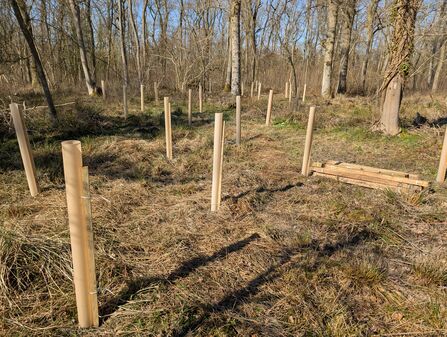
Snitterfield Bushes - Planting and tree guards
Bubbenhall Wood
An ancient woodland that sits close to two other important woodlands, Ryton Wood and Wappenbury Wood, Bubbenhall Wood has previously been managed as traditional “coppice with standards”. This is where smaller trees such as hazel are cut regularly to promote growth of small branchy timber, and other trees such as oak are left alone dotted amongst the hazel to grow into large trees. As this sort of timber became uneconomical these areas were left untouched and the smaller trees became shaded out by the larger trees. This resulted in the density of the “coppice” underneath reducing.
Since taking on the nature reserve, we have reintroduced coppice management and thinned some of the larger trees to provide light. This encourages the denser structure required for wildlife such as nesting birds and dormice. As some of the smaller trees had died off, we planted new trees in the gaps that will be coppiced in the future.
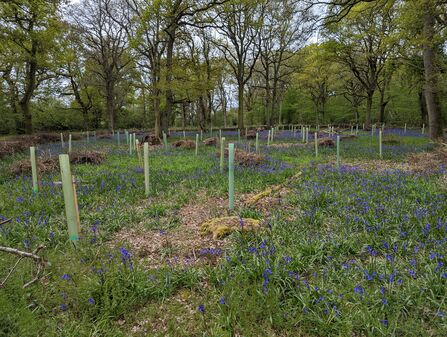
Bubbenhall Wood
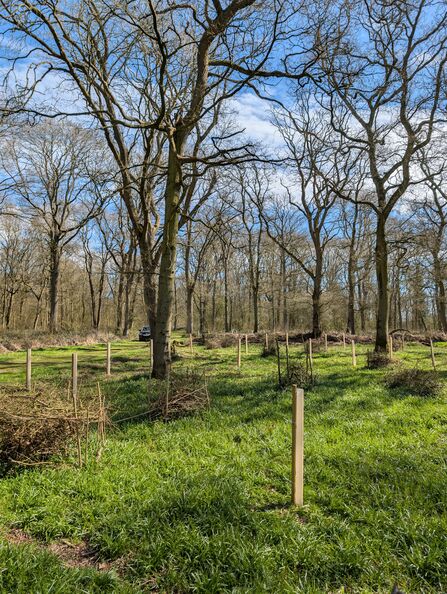
Bubbenhall Wood tree planting - old and new
Piles Coppice
Managing a woodland for diversity of structure and wildlife often requires thinning out areas and “coppicing” trees (repeated cutting to encourage new branchy growth).
At Piles Coppice, we reintroduced management such as this in 2022 to encourage the growth of new trees and coppiced lime and hazel. Small trees are easy targets for deer which chew off the new growth and prevent them from maturing. In Piles Coppice we have used temporary deer fencing as an alternative to planting trees and installing tree guards. This will allow for trees to grow naturally from local seeds which are likely better adapted to the conditions. The fencing will be removed once the trees are big enough to avoid damage from deer.
We have also trialled a method called “layering” where parts of a small tree are pegged down and buried to encourage rooting. This effectively creates a new tree clone and increases the density of the coppiced trees.
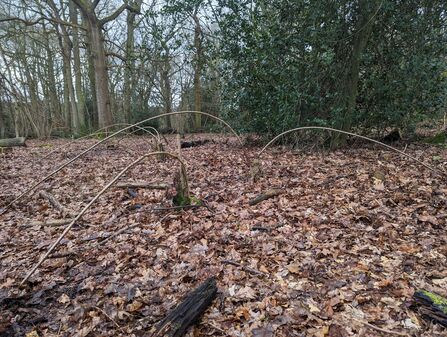
Piles Coppice layered hazel regrowth
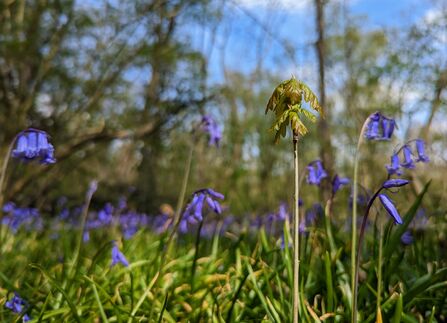
Oak tree growing at Piles Coppice


